Research Reports
Jun 29 2018
Research of NW Coast
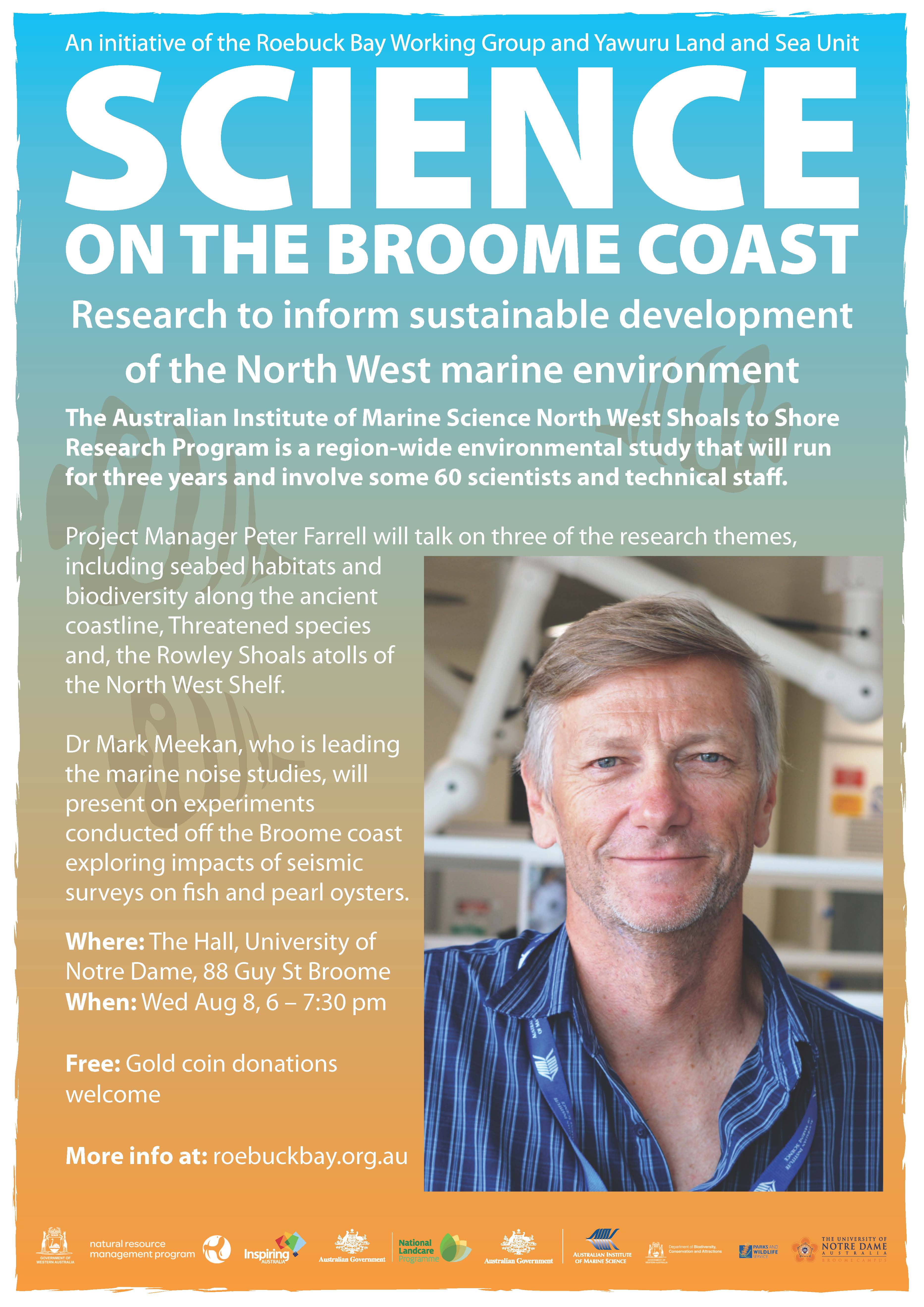 AUGUST 8, 2018
Research to inform sustainable development of the northwest coast
The AIMS North West Shoals to Shore Research Program is a three year region-wide study involving 60 scientists and technical staff.
Peter Farrell will present three themes:
– Seabed biodiversity along an ancient coastline
– Threatened species
– Rowley Shoals atolls
Dr Mark Meekan (leading marine noise studies) will present on impacts of seismic surveys on fish and pearl oysters.
Where The Hall, University of Notre Dame, 88 Guy St, Broome
When Wednesday August 8, 6 – 7:30pm
Free Gold coin donation welcome
Mar 29 2018
Shorebird Congress Sept 8-9, 2018
 Would you like to learn about Roebuck Bay’s remarkable migratory shorebirds and be part of 30th birthday celebrations for the Broome Bird Observatory? Well put aside Sept 8-9, 2018 to hear a series of fascinating presentations put on by the Broome Bird Observatory and Birdlife-Australia. The full list of presenters will be out soon with a brief description of each talk. Register on Broome Bird Observatory website or call direct 08 91935600.
Nov 29 2017
Changing tide for shorebirds
 There is a great story on a Question of Balance about the work being undertaken by Chris Hassell, a long term researcher with the Global Flyway Network in Broome to better understand the pressures that face migratory shorebirds on their annual breeding migration. Read the story »
Nov 13 2017
Kimberley coral research
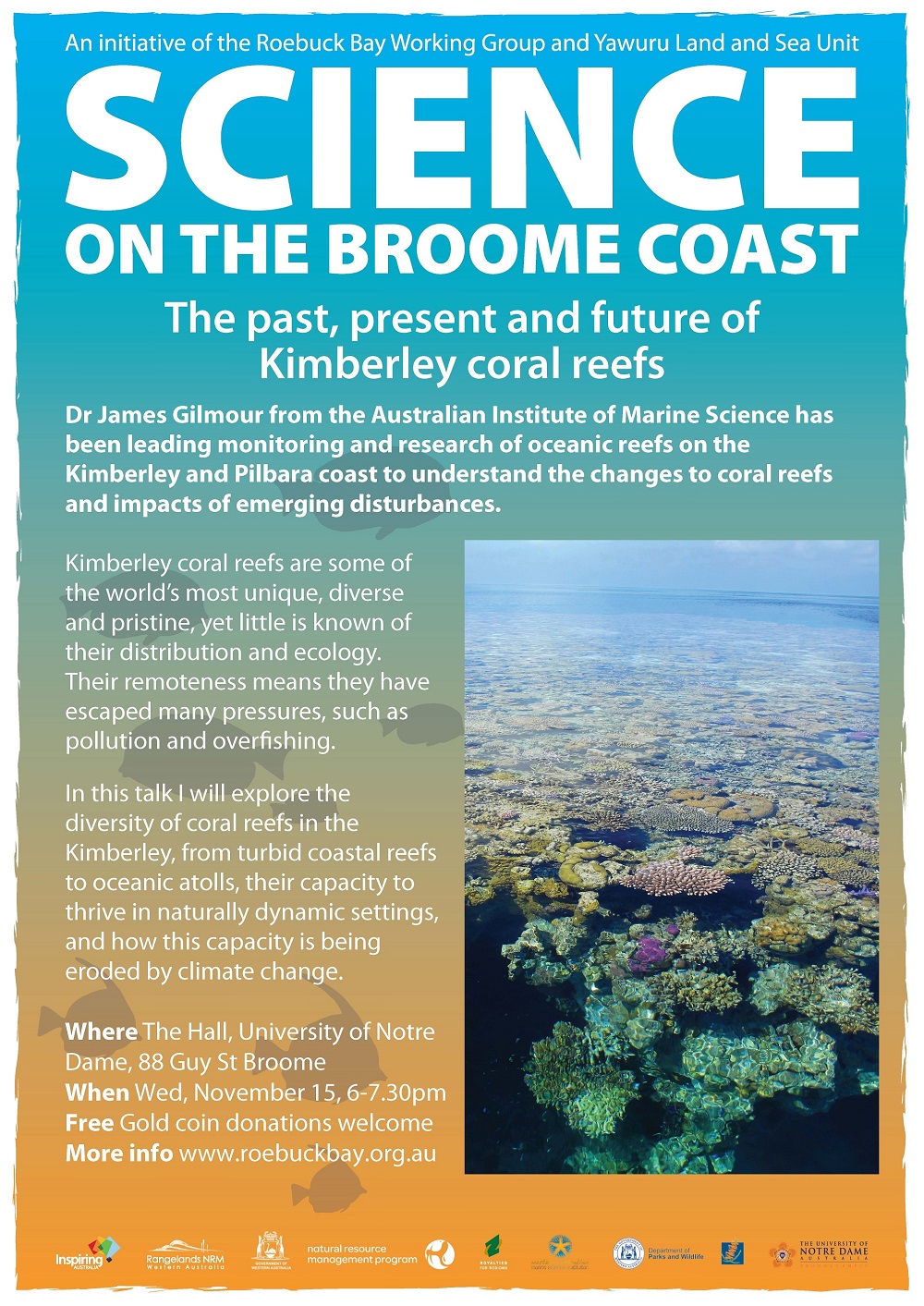
Dr James Gilmour studies Kimberley coral reefs and their capacity to thrive in dynamic settings; climate change however, is challenging their resilience. Dr Jim Underwood studies coral reef animals, like fish, corals and seagrass, which release larvae or seeds to form ‘recruits’. How far do larvae and seeds move on currents before they settle and grow to adults. When corals bleach, will new recruits come from local survivors or from reefs far away? Wed, Nov 15, The Hall, University of Notre Dame, Broome.
Oct 26 2017
Human use of Dampier Peninsula
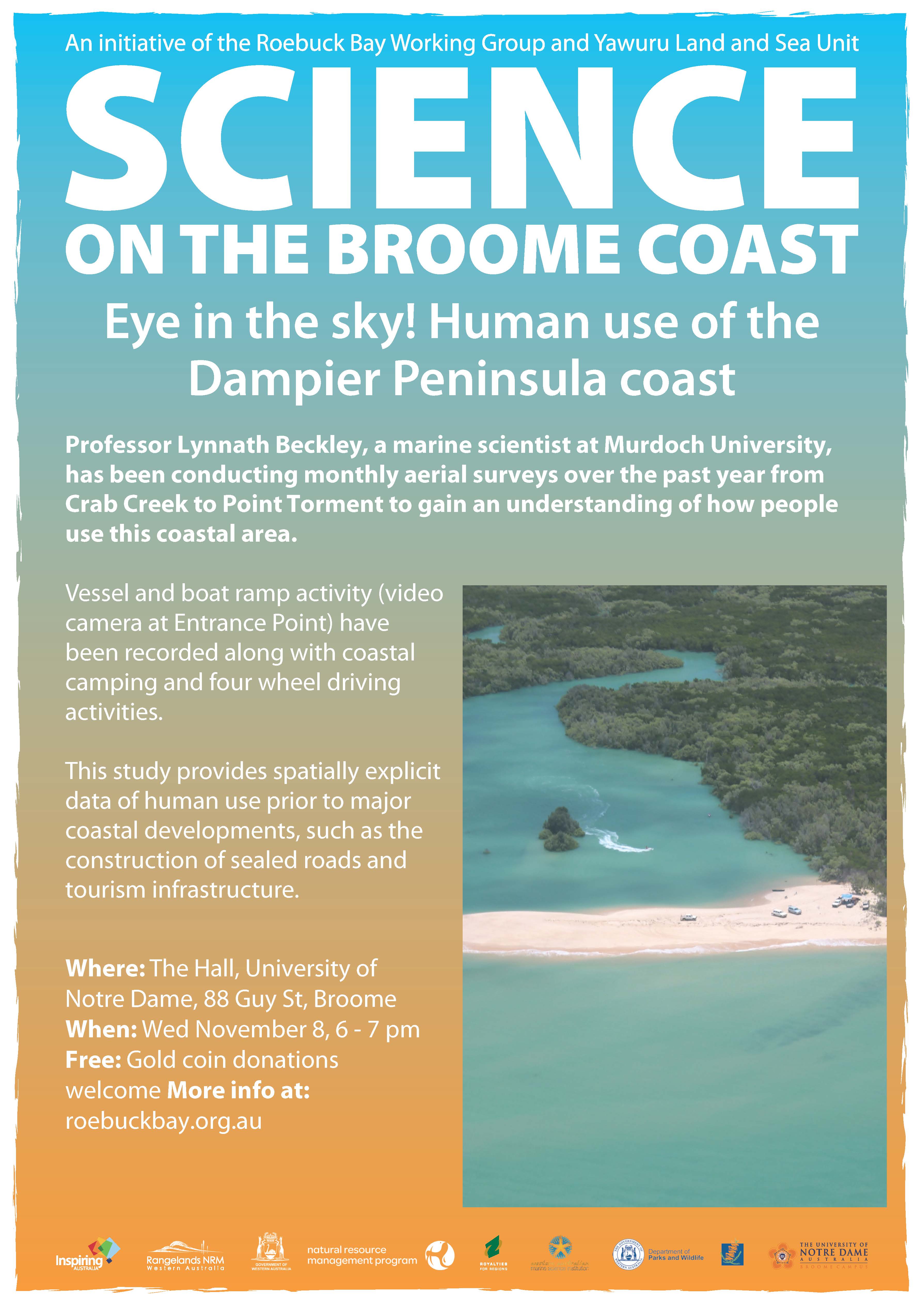 NOVEMBER 8, 2017
Eye in the sky! Human use of the Dampier Peninsula
Professor Lynnath Beckley, a marine scientist at Murdoch University, has been conducting monthly aerial surveys over the past year from Crab Creek to Point Torment to gain an understanding of how people use this coastal area.
Vessel and boat ramp activity (video camera at Entrance Point) have been recorded along with coastal camping and four wheel driving activities. This study provides spatially explicit data of human use prior to major coastal developments, such as the construction of sealed roads and tourism infrastructure.
Where The Hall, University of Notre Dame, 88 Guy St Broome
When Wednesday November 8 from 6 – 7.00pm
Free Gold coin donations welcome 🙂
Sep 26 2017
Counting Balguja – the sea cow
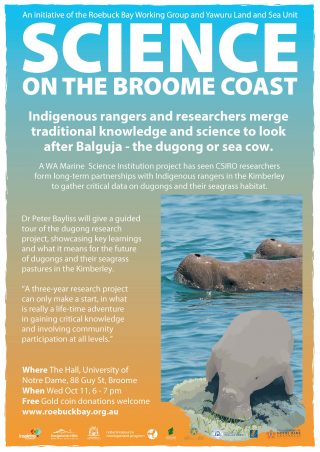 Indigenous rangers and researchers merge knowledge and science to look after Balguja – the sea cow
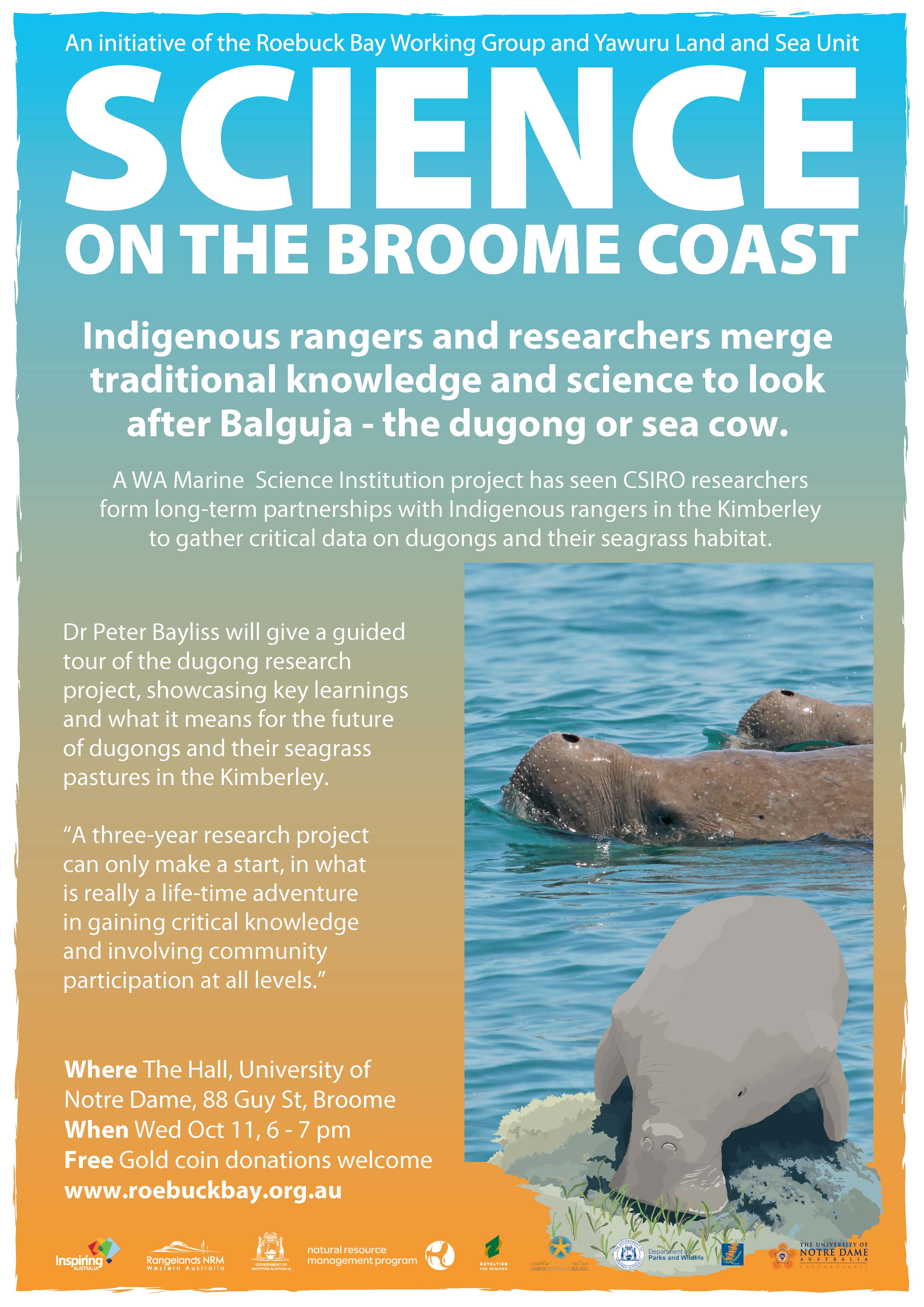
Researchers have partnered Indigenous rangers in the Kimberley to gather critical data on dugongs and their seagrass habitat for a WA Marine Science Institution project.
Dr Peter Bayliss explains key learnings and what they mean for dugongs and their seagrass pastures in the Kimberley.
“This three-year research project makes a start in a life-time adventure to gain critical knowledge with community participation at all levels.”
Where The Hall, University of Notre Dame,
88 Guy St, Broome
When Wednesday October 11 from 6 – 7.00pm
Free Gold coin donations welcome 🙂
Aug 23 2017
Whale and dolphin communication
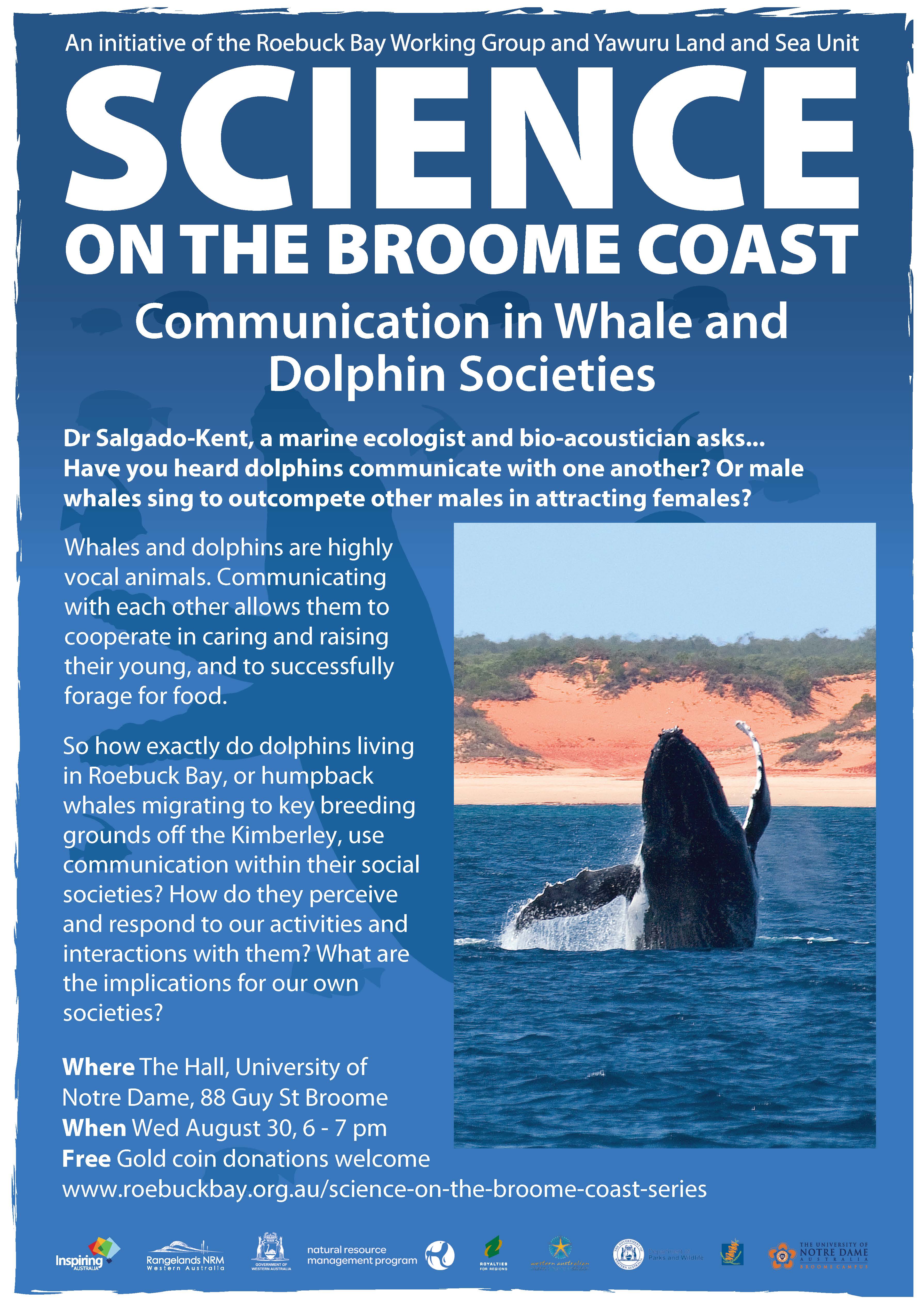 Dr Salgado Kent, marine biologist and bioacoustician asks… Have you ever heard dolphins communicate with one another? Or male whales sing to outcompete other males in attracting females?
So how do dolphins living in Roebuck Bay or humpback whales migrating key breeding grounds off the Kimberley use communication within their social societies?
Where The Hall, Univ Notre Dame, 88 Guy St, Broome
When Wednesday August 30 from 6 – 7 pm
More information »
Jun 27 2017
RBWG eNewsletter
Read about the innovative work of the Roebuck Bay Working Group in the latest RBWG eNewsletter June 2017.
As you will read, we have plenty going on that you can get involved in – a Mud and Saltwater Short Film Fest on August 5, 2017. If you are a filmmaker and wish to get involved, please do, but remember, the short films are due in on July 15, 2017. You can submit your film through Film Freeway on http://mudandsaltwater.org.au/entering-films/
The Roebuck Bay Working Group also runs a Science on the Broome Coast series. Check out the presentations coming up and come along, they are all free events and you will discover a lot about Roebuck Bay and the Kimberley coast.
Enjoy reading our eNewsletter and let us know if you want any further information about any of the events we put on.
Jun 16 2017
Celebrate the Dinosaur Coast
 JULY 1-15, 2017
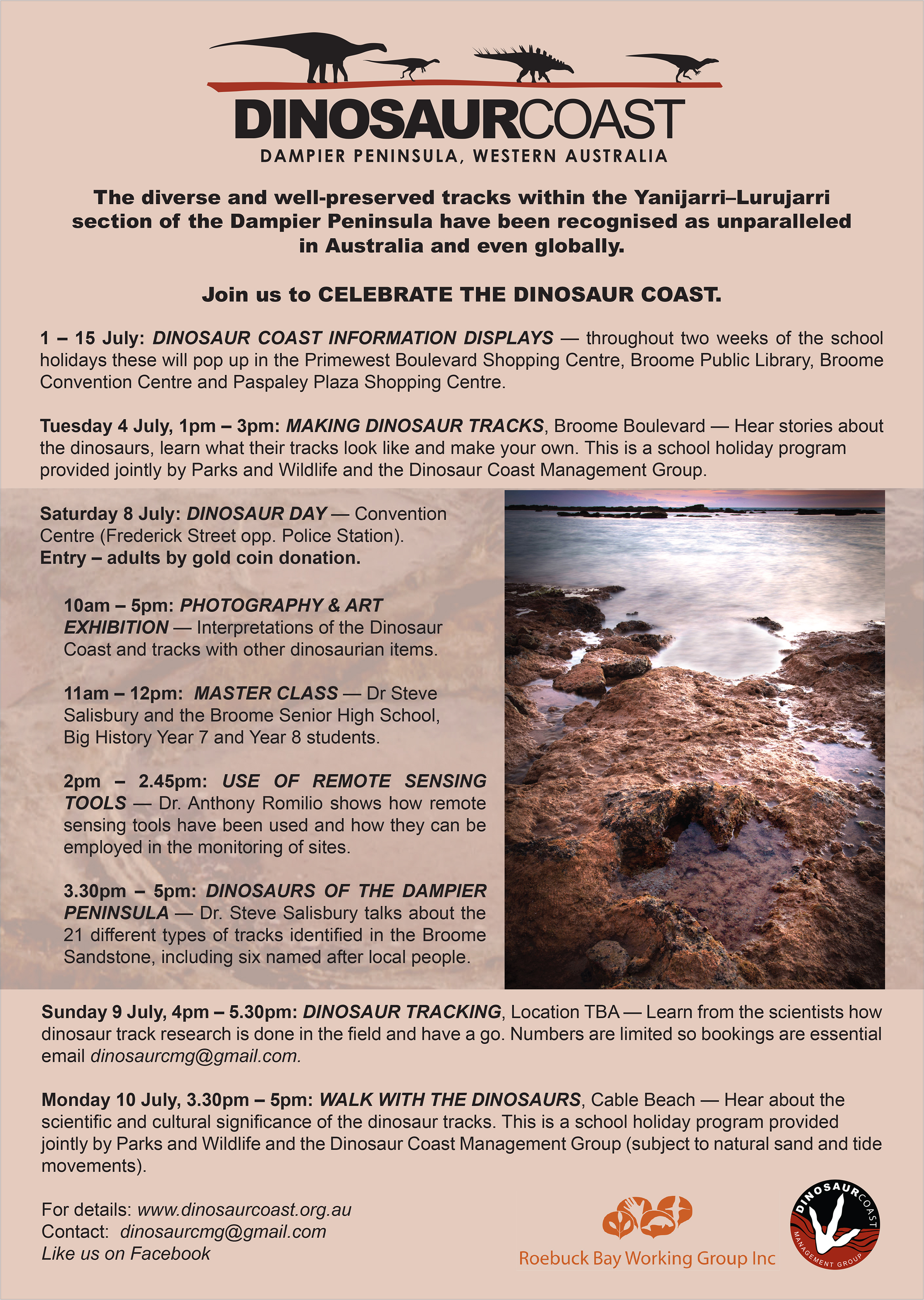
CELEBRATE THE DINOSAUR COAST
Celebrate the Dinosaur Coast is organised by the Dinosaur Coast Management Group (DCMG) in partnership with the Roebuck Bay Working Group (RBWG). Micklo Corpus, DCMG Chairperson said, ‘This is a great opportunity for the whole community to learn more about the dinosaurs who used to call Broome and beyond home.’ RBWG Project Manager Kandy Curran said, ‘this is a stand out for 2017, with lots of hands on dinosaurian activities led by two of Australia’s leading paleontologists.’
Research published in Society of Vertebrate Paleontology Memoir 16 (Mar 2017) has captured international and national attention. Led by Dr Steve Salisbury (University of Queensland), the work established the rich diversity of well-preserved tracks on the Yanijarri-Lurrajarri section of the Dampier Peninsula coastline as unparalleled.
May 3 2017
Finding the night parrot
 The 2017 Science on the Broome Coast series is underway, starting on May 24 with the exciting story…
The night parrot – how one of the world’s most enigmatic species was rediscovered in WA.
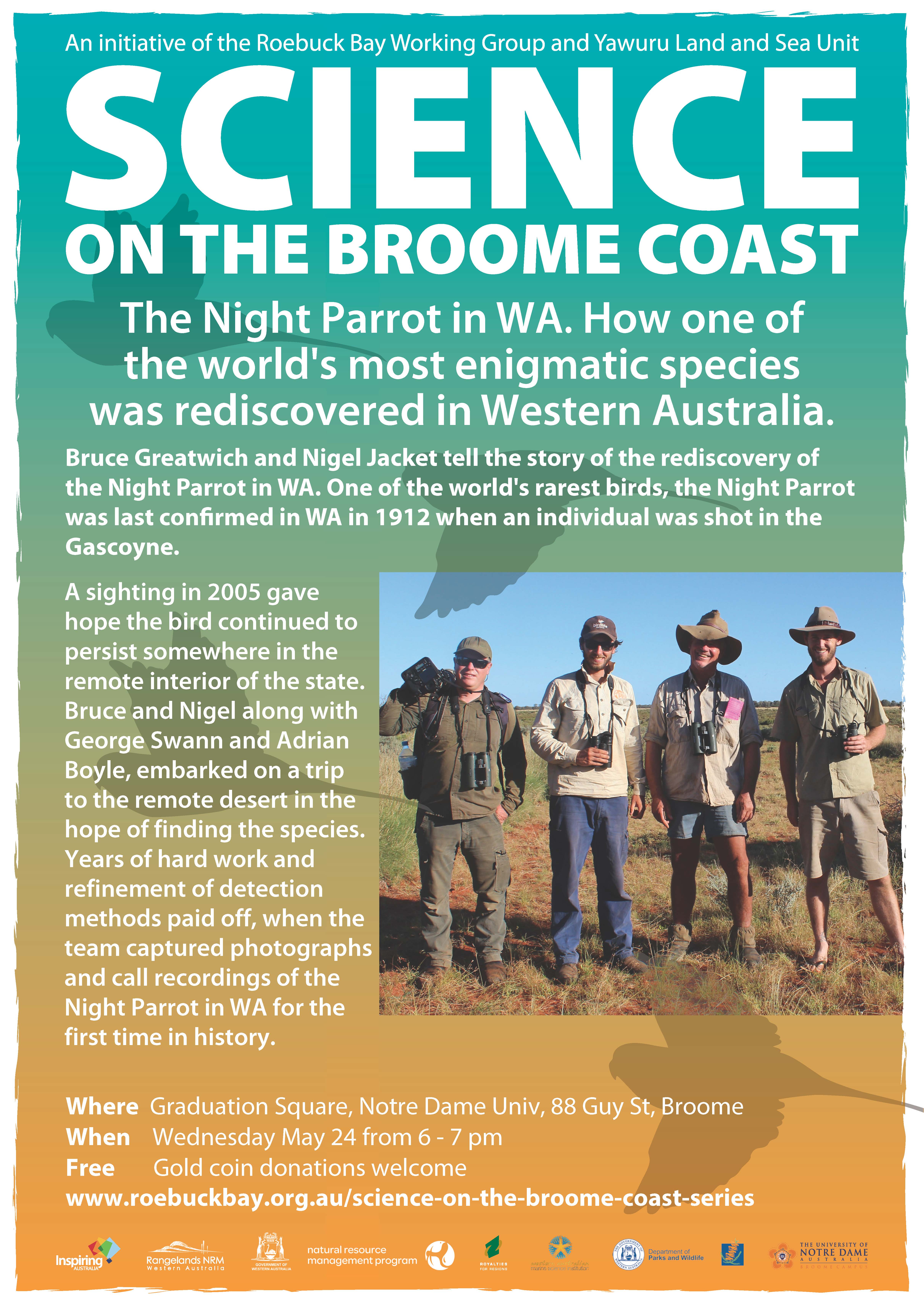
Arguably one of the world’s rarest bird species, the Night Parrot was last confirmed in WA, when in 1912 an individual was shot in the Gascoyne region. Bruce Greatwich and Nigel Jackett, along with George Swann and Adrian Boyle embarked on a trip to the remote desert in the hope of finding the species. Many years of hard work and refinement of detection methods paid off, when the team was able to capture photographs and call recordings of the Night Parrot in WA for the first time in history.
Where Graduation Square, University of Notre Dame, 88 Guy St Broome
When Wednesday May 24 from 6 – 7.30pm
« Previous Entries Next Entries »