Research Reports
Feb 29 2016
Presentation on wastewater plant
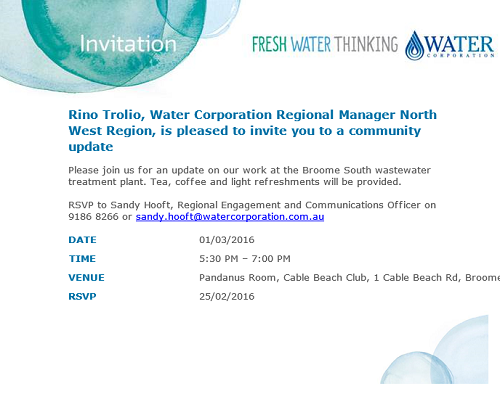 Water Corp invites you to a community update on the contamination issues at Broome South Waste Water Treatment Plant and the Broome Golf Course, on Tues March 1, 2016. Water Corp General Manager Rino Triolo will provide the presentation which will focus on projects to reduce flows at the the Broome South Waste Water Treatment Plant to reduce the likelihood of treated wastewater seeping from the ponds and progress of environmental investigations being undertaken by Water Corp and the Department of Environment Regulation.
Sep 7 2015
Can bilbies and cats co-exist?
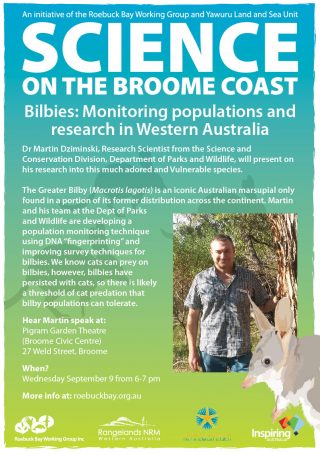 ith Greater bilbys only found in a portion of its habitat in Australia, it is exciting that populations have been found in the Broome Shire. Bilby scientist Dr Martin Dziminsky and Dr Malcolm LIndsay provided presentations on September 9, 2015 as part of the Science on the Broome Coast series, on the new methods to monitor their populations and the research underway in the Kimberley with ranger groups. Here is a story written about the research on Science Network WA »
This wonderful series is being run by the Roebuck Bay Working Group and Yawuru Land and Sea Unit.
Sponsors: Inspiring Australia, Rangelands NRM, WA Marine Science Institution and Broome Shire Council.
Jun 29 2015
Dinosaurs, drones and lasers
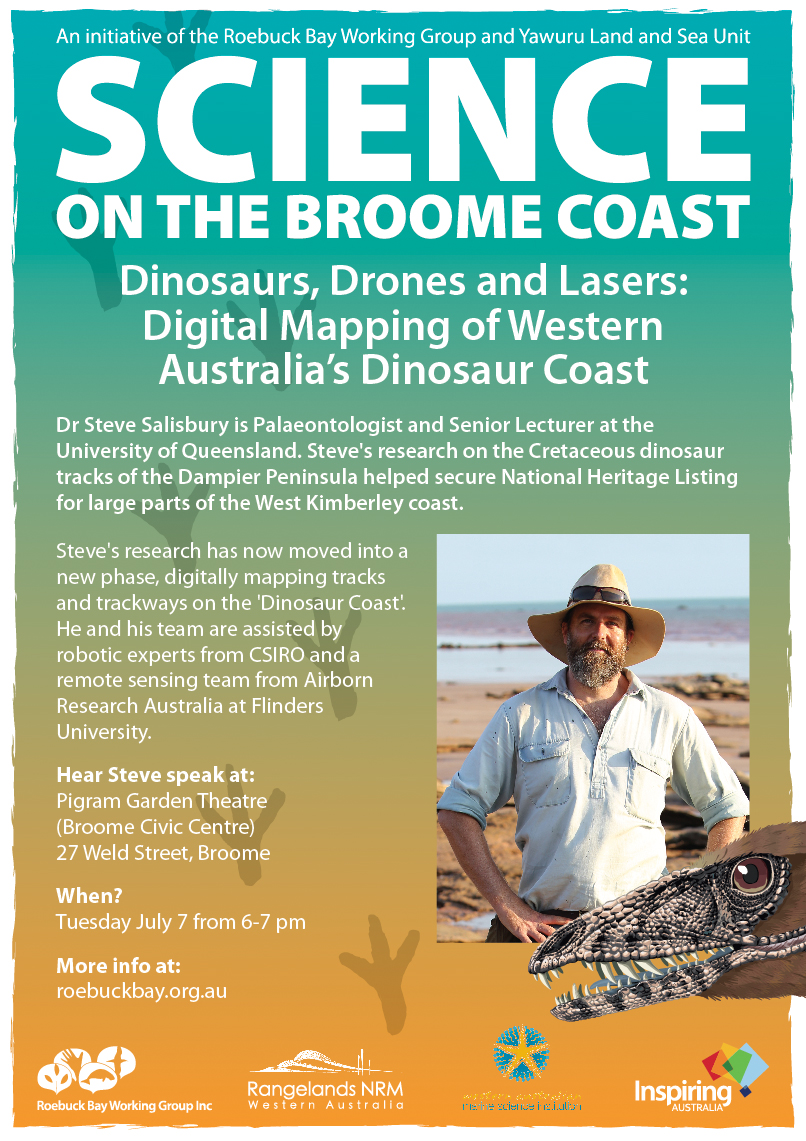 Great opportunity on July 7 to hear Palaeontologist Dr Steven Salisbury’s presentation on the Cretaceous dinosaur tracks of the Dampier Peninsula. With the help of robotic experts from CSIRO and a remote sensing team from Airborne Research Australia, Dr Salisbury and his team has been recording hundreds of tracks along the West Kimberley coastline with drones, ladar aircraft and photo imaging. Using sophisticated software, the advanced digital vision they have collected is creating three dimensional images of the tracks, which will provide an invaluable resource for conservation and research into the future. Steve will walk you in the footsteps of dinosaurs – awesome!
The series is run by Roebuck Bay Working Group Inc and Yawuru Land and Sea Unit, and sponsored by Inspiring Australia, Rangelands NRM and Western Australian Marine Science Institution.
May 29 2015
Tracking journeys of shorebirds
 The 2015 Science on the Broome Coast series is underway again (program in coming days). The series showcases the exciting marine research underway on Roebuck Bay and the Kimberley coast.
On June its Chris Hassell from the Global Flyway Network. In July, Lasers, Dinosaurs, drones and lasers, and a Ngalagun Roebuck Bay Marine Park. In August it’s bilby survival, then in October, jellyfish in Broome’s coastal waters and current sting treatments.
The series is run by Roebuck Bay Working Group and Yawuru Land and Sea and sponsored by Inspiring Australia, Rangelands NRM, Western Australia Marine Science Institution.
Feb 23 2015
Muddy invertebrates are fattening
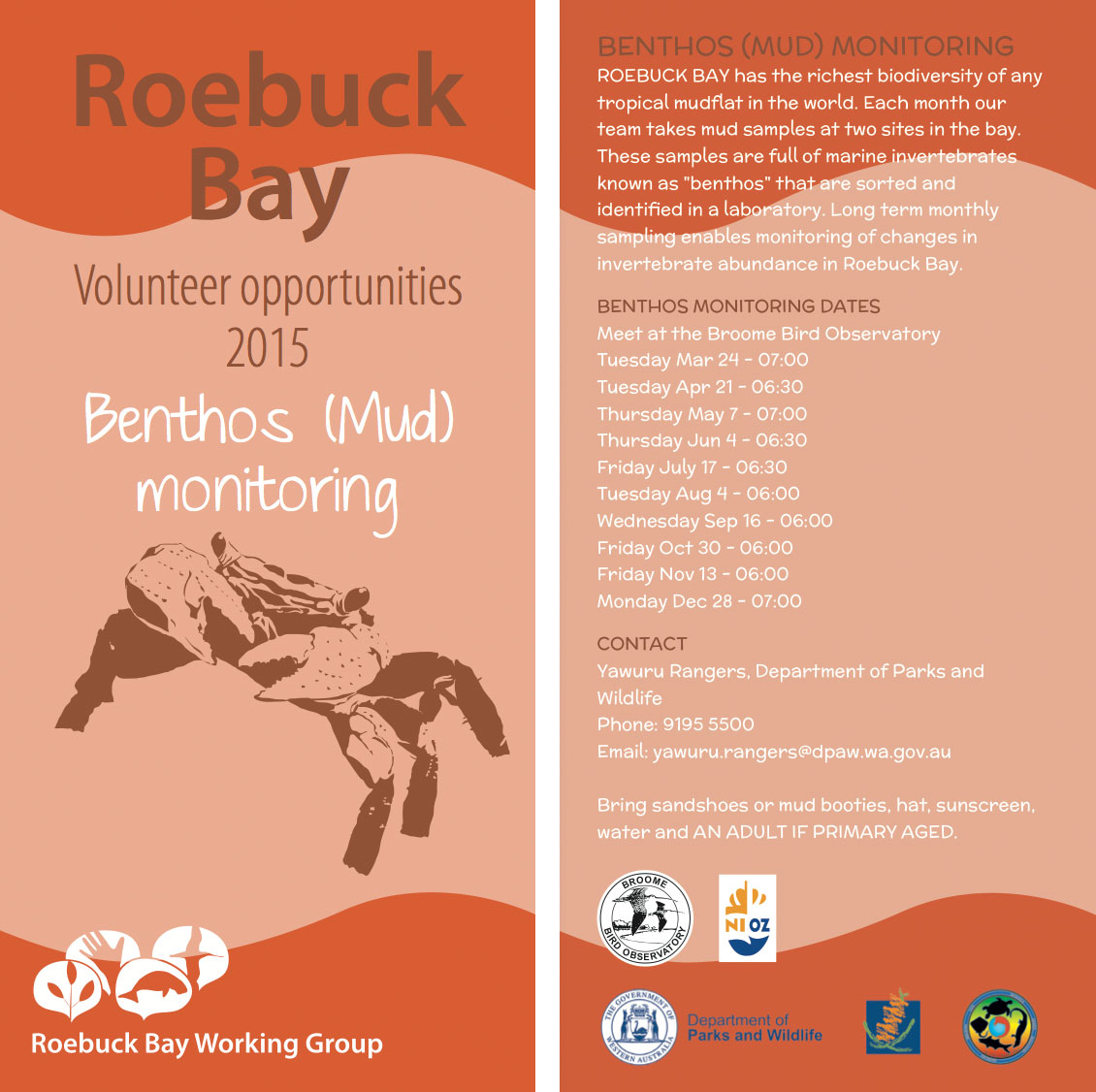 ROEBUCK BAY has the richest biodiversity of any tropical mudflat in the world. Each month mud samples are taken at two sites in the bay. These samples are full of marine invertebrates known as “benthos” that are sorted and identified in a laboratory at the Broome Bird Observatory. Long term monthly sampling enables monitoring of changes in invertebrate abundance in Roebuck Bay. If you want to help monitor the invertebrates that fatten up shorebirds for their annual migration, well here are the dates and details for you.
Aug 1 2014
Coastal volunteering
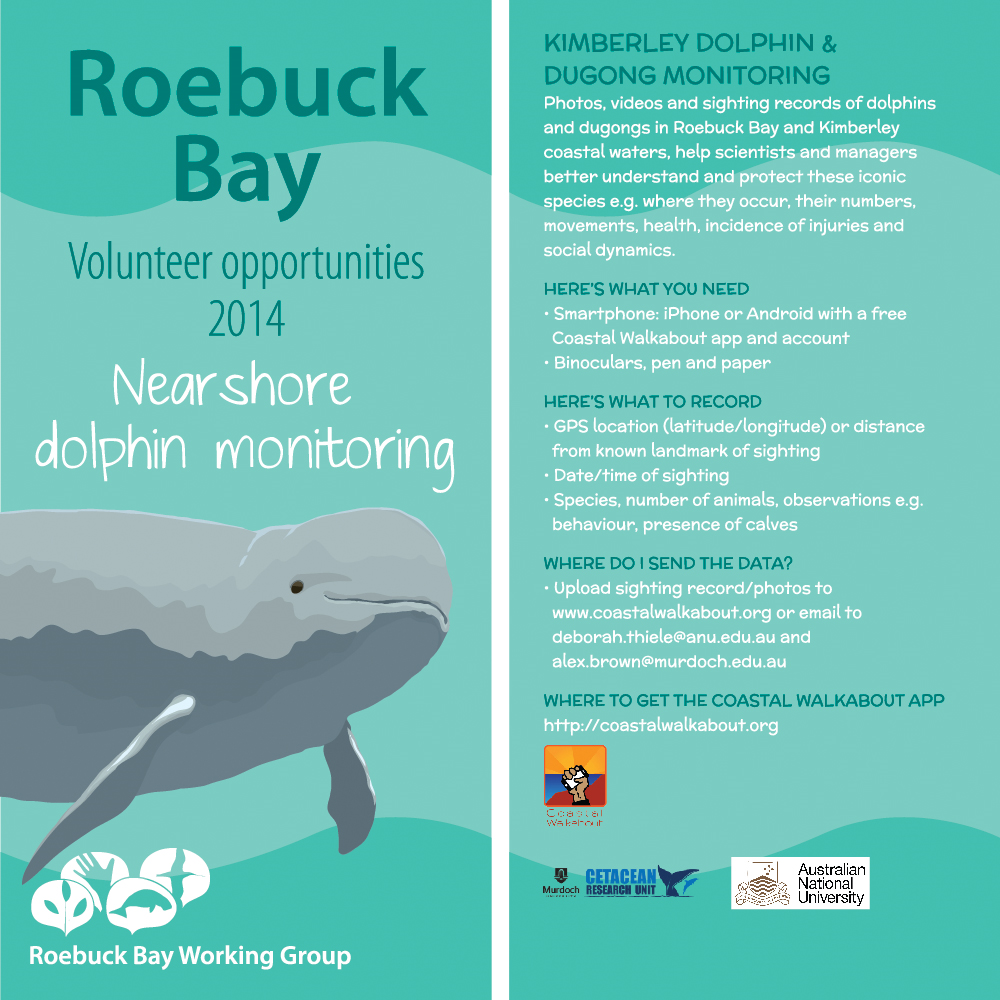 Love dolphins and dugongs and love being out on the water? Well here is your chance to contribute by uploading photos and sightings of dolphins and dugongs in near shore waters along the Kimberley coast to a dedicated website? The Roebuck Bay Working Group has developed these wonderful cards that illustrate so beautifully, coastal projects being run by scientists such as Dr Deb Thiele and PhD researcher Alex Brown, that are in need of volunteer help.
Jun 11 2014
Dutch Nobel prize for researcher
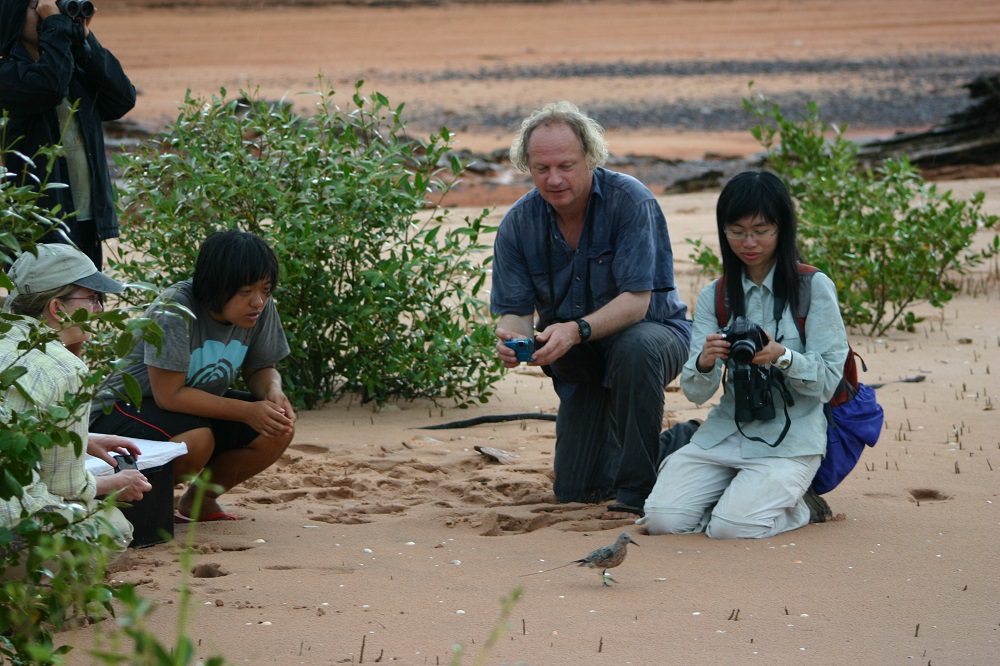
Nobel Prize laureate Professor Piersma releasing a satellite tagged migratory shorebird on Roebuck Bay.
Professor Theunis Piersma has won the Dutch Nobel Prize (Spinoza) for his work on migratory shorebirds » Heartiest congratulations from the RBWG. Theunis’ work on Roebuck Bay has been outstanding, not only with migratory shorebirds, but also with the invertebrates in the bay’s mudflats that are the food source that fuels their extraordinary migrations each year.
Theunis is the leading authority on global shorebird and benthic ecology, and being forward thinking, started the Roebuck Bay benthos monitoring program in 1999. This long term monitoring study is still underway today and being carried out by Yawuru Rangers at DPaW and Wardens at the Broome Bird Observatory. Theunis (Team Leader of the Global Flyway Network) employs Chris Hassell, the only on ground researcher focused on Roebuck Bay’s shorebirds and benthos. Theunis is a Professor of Animal Ecology, Head of the Animal Ecology Group, Centre for Ecological and Evolutionary Studies (CEES), book author (Life along lands edge and many more) and supervisor of many doctoral and post-doctoral students. And as you would expect, as well as the Dutch Nobel Prize, Theunis is the recipient of many other illustrious scientific awards – an exemplary example is the internationally acclaimed Luc Hoffmann Medal for Excellence in Science and Conservation, awarded by Wetlands International.
Jun 10 2014
Food for Lyngbya blooms

Most of Broome’s stormwater drains discharge into Roebuck Bay, so better to grow native plants that dont need fertilser that can feed blooms of Lyngbya.
Read about the practical research underway to explain why Roebuck Bay has been experiencing Lyngbya blooms, and what can be done about it. Great work scientists Gayan Gunaratne, Assoc Prof Ryan Vogwill, Nick Wright and Daniel Hearn and Yawuru Rangers, Roebuck Bay Working Group and Rangelands NRM for providing funding support.
Here is the link to the feature on Science Network WA »
Nov 11 2013
Award Winning Lyngbya Research
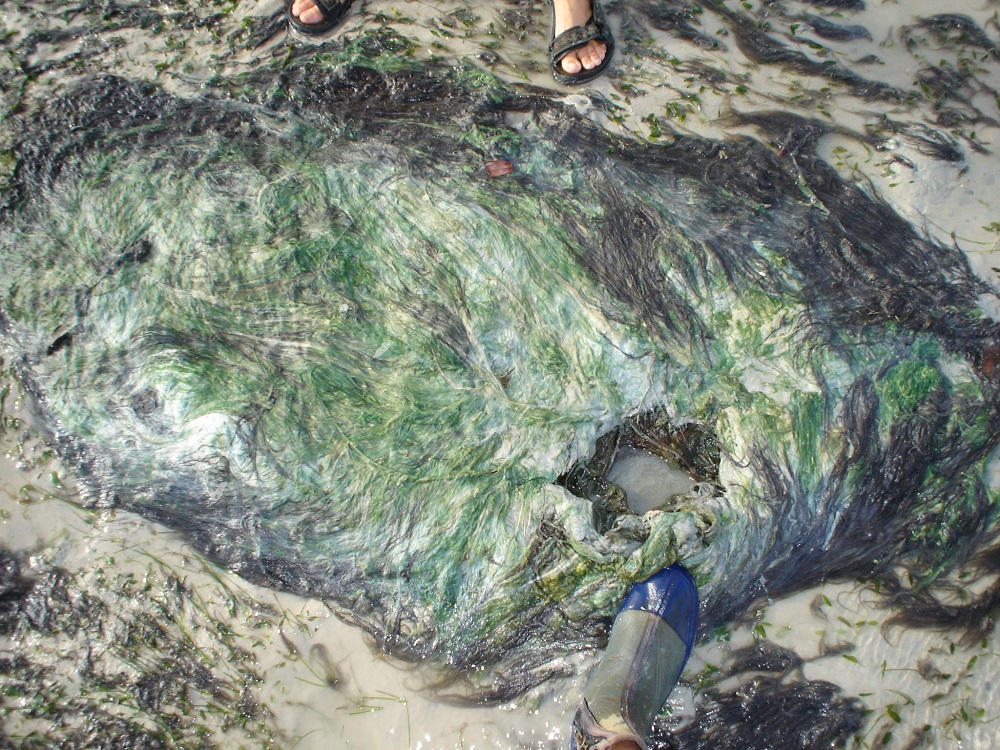
Lyngbya is a cyanobacteria that grows quickly when fed nutrients that can come from wastewater, fertilisers, animal faecies and garden waste.
A team of scientists headed by Assoc Professor Ryan Vogwill at the University of Western Australia have won an outstanding award. They have been working with the Department of Parks Wildlife staff in Broome, Yawuru Rangers, RBWG and volunteers from Broome community to help us understand why Lyngbya blooms have been occurring in Roebuck Bay in recent years.
The Broome Lyngbya Taskforce won the award for ‘bringing together the community to discover the role of nutrient inputs in the proliferation of noxious algae in Roebuck Bay’.
Sep 16 2013
The story of Guwayi goes viral
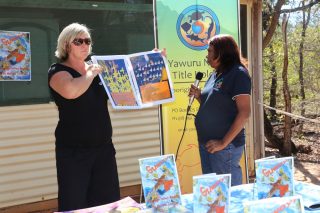
Book reading by Maxine Charlie, author and illustrator of Guwayi the Bar-tailed Godwit. © Kandy Curran
The feature article about Maxine Charlie’s wonderful book Guwayi is being read across the world 🙂
Thanks Maxine Charlie and Global Flyway Researcher Chris Hassell for your outstanding efforts to look after this remarkable international travellers. Here is the feature article that is on Science Network WA, in the Broome Advertiser and Partnership for the East Asian-Australasian Flyway »
« Previous Entries Next Entries »